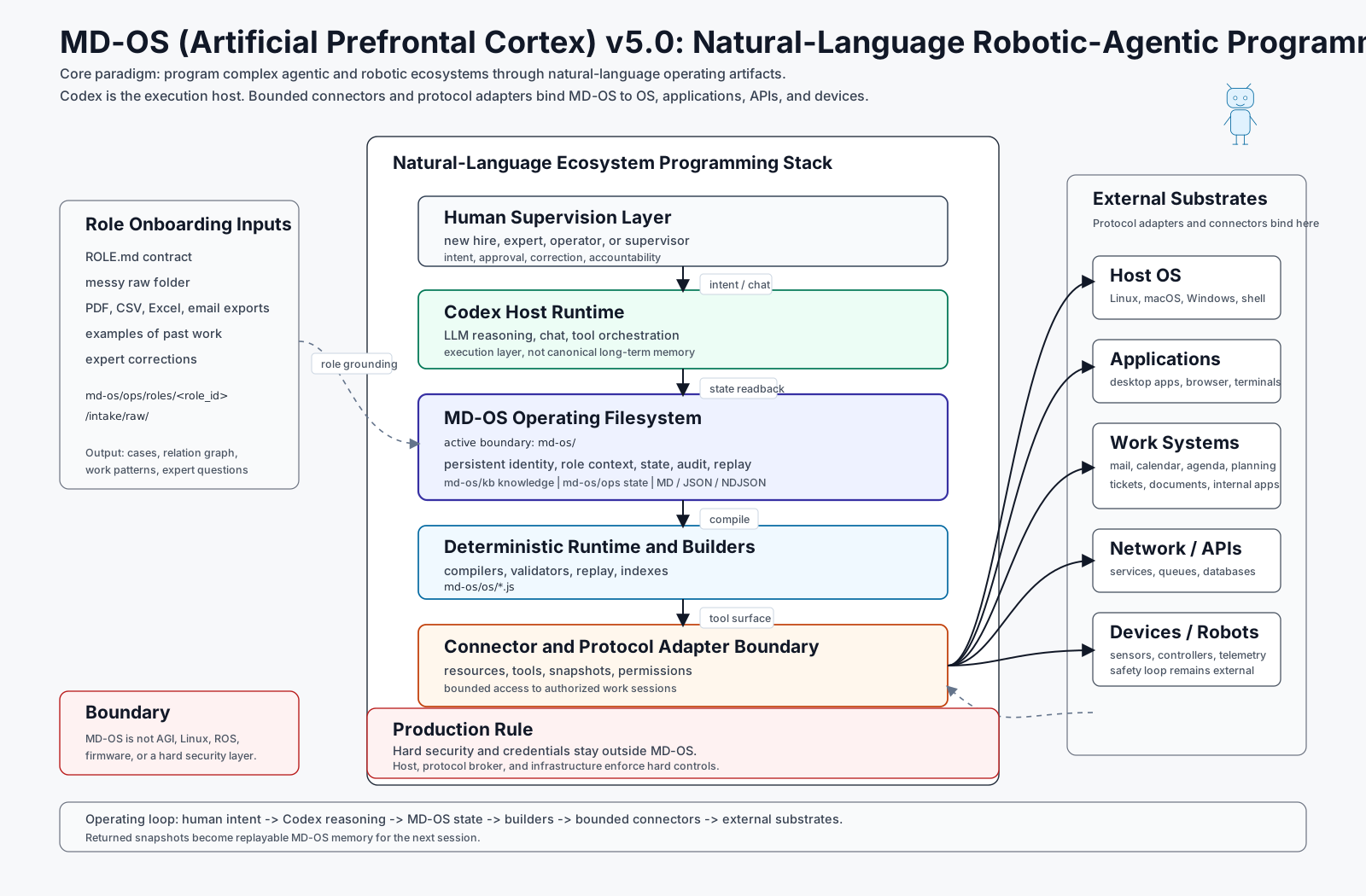
MD-OS (Artificial Prefrontal Cortex) v5.0 can be described as a semantic-operational runtime wrapped around a static LLM core.
This model gives precise language for the MD-OS architecture schema. It is a conceptual and architectural model, not a claim that MD-OS changes foundation-model weights or creates an internal neural network inside the LLM.
A standard LLM mostly operates through this loop:
prompt -> inference -> response
MD-OS adds a persistent semantic-operational layer around that loop:
natural-language intent
  -> semantic task
  -> policy check
  -> connector selection
  -> bounded action or observation
  -> artifact or snapshot
  -> deterministic state rebuild
  -> active memory
  -> next semantic action proposal
In compact form:
Static LLM + MD-OS Semantic Runtime = Dynamic Virtual LLM
Or:
M0 + S_MD(t) -> Mv(t)
Where:
M0      = the monolithic static LLM or host reasoning model
S_MD(t) = the evolving MD-OS semantic runtime over time
Mv(t)   = the dynamic virtual model produced by their combined operation
Mv(t) is not a new trained foundation model. It is the externally
materialized behavior of a model operating through persistent tasks,
connectors, policies, snapshots, active memory, semantic actions, deterministic
builders, and audit state.
The semantic neural overlay is:
It is not:
The analogy is:
LLM:
linguistic context + missing word -> next token

MD-OS:
operational context + missing step -> next semantic task
The central shift is:
LLMs complete words.
MD-OS completes supervised operational tasks.
This does not mean every proposed task should be executed. It means MD-OS can detect operational gaps, propose candidate next actions, route them through policy, select bounded connectors, and preserve the resulting artifacts.
MD-OS may be described as a semantic operating system for agents if the phrase is kept inside the repository’s non-claims.
The phrase means:
semantic operating system for agents
= semantic Operating Filesystem
+ persistent operating context
+ bounded connectors
+ deterministic builders
+ inspectable state transitions
It does not mean:
kernel
Linux replacement
robotics middleware replacement
AGI claim
sentience claim
unrestricted autonomous authority
The stricter architectural term remains:
Markdown-native Operating Filesystem
The public-facing term is useful because it captures the central operating shift: language is no longer only prompt text. It becomes a control surface for supervised semantic actions over persistent state.
The task-completion layer reads operational context such as:
It can then identify gaps such as:
The proposal path is:
semantic gap
  -> candidate task
  -> policy check
  -> connector or builder selection
  -> action schedule or human approval request
MD-OS creates an inspectable semantic space around the model. Operational context is not one flat prompt; it is a set of dimensions:
These dimensions constrain and enable candidate next actions. In compact form:
semantic dimensions + bounded procedures + persistent state
  -> semantic action field
  -> supervised task completion
The intelligence is operationally emergent in a practical, auditable sense. A single semantic unit may be simple: classify a task, check a policy, select a connector, rebuild an index, or record an artifact. Many small units can cooperate through the filesystem, builders, state machines, and connector contracts to produce a larger field of useful next actions.
The field remains bounded. MD-OS does not execute all possible actions. It proposes or performs actions only through policy, connector capability, permission, and explicit state transition rules.
The semantic neural overlay can be stated more directly:
MD-OS virtualizes semantic-operational nodes on disk.
These nodes are analogous to neural nodes by operating role, not by physical or mathematical substrate. They are not:
biological neurons
foundation-model weights
hidden model activations
a numerical neural network
an independently trained model
They are inspectable operating objects:
Markdown knowledge files
natural-language programs
work items
policies
permission profiles
connector registry entries
snapshots
journal events
artifacts
generated indexes
state transitions
Their connections are also filesystem objects:
Markdown links
graph edges
project relations
work-item dependencies
connector routes
builder inputs and outputs
agenda schedules
replay evidence
This is why the neural metaphor is useful but bounded. MD-OS externalizes part of the operational structure that would otherwise remain implicit in a model’s transient reasoning context. The result is a persistent, readable, correctable, and replayable semantic-operational network on disk.
In MD-OS, an action is not merely a shell command or tool call. It is a meaningful state transition under constraints.
Semantic Action =
  Intent
  + Context
  + Capability
  + Policy
  + Trigger
  + State Transition
  + Artifact
Or:
As = f(intent, context, capability, policy, trigger, state_transition, artifact)
A semantic action says:
perform this meaningful state transition,
under these constraints,
using this bounded connector or deterministic builder,
and record the result as a persistent artifact or snapshot
This is different from:
run this command
The command, if one exists, is only the substrate-level implementation detail. The semantic action is the inspectable operating object.
An agenda says:
what should be done and when
A semantic action schedule says:
which action makes sense in the current state,
with which connector or builder,
under which policy,
with which expected artifact,
and with which state transition
The schedule is therefore not only temporal. It is semantic, contextual, policy-governed, and auditable.
The neural metaphor is useful only if it remains external and semantic.
The mapping is:
LLM core          -> central reasoning nucleus
MD-OS runtime     -> external semantic control plane
connectors        -> operational synapses
tasks             -> active semantic units
snapshots         -> memory traces
policies          -> inhibitory/control mechanisms
active memory     -> working memory
semantic actions  -> motor outputs
task completion   -> predictive operational completion
state rebuild     -> plasticity over time
The nodes are not neurons in the machine-learning sense. They are operating artifacts:
The edges are also operating artifacts or reconstructible relations:
The semantic runtime is already partially represented by current MD-OS files:
| Runtime concept | MD-OS representation |
|---|---|
| Tasks | md-os/ops/projects/*/project.json, work items, agendas |
| Active memory | md-os/ops/projects/*/active_memory.*, md-os/ops/summary/*, md-os/ops/core/* |
| Connectors | md-os/ops/connectors/connector_registry.json, connector profiles, md-os/os/*_connector.js |
| Snapshots | md-os/ops/sources/**, md-os/ops/artifacts/**, journal events |
| Policies | md-os/kb/PERMISSION_MODEL.md, connector profiles, safety models |
| Semantic actions | natural-language programs, connector runs, builders, proposed state transitions |
| State rebuild | deterministic builders under md-os/os/ and cortex replay |
| Runtime graph | md-os/ops/markdown_graph.*, project relations, explicit Markdown links |
| Audit | md-os/ops/journal.ndjson, replay report, generated status files |
The next implementation maturity step is not blind autonomy. It is a bounded task-completion engine that can produce auditable candidate tasks.
Such an engine should:
In the current 5.0 release, the human interlocutor remains the primary high-level generator. Natural language triggers the operating loop:
human instruction
  -> generated task candidate
  -> policy filter
  -> connector or builder selection
  -> controlled execution or proposal
  -> snapshot or artifact
  -> state update
A future daemon may propose tasks automatically, but the governance rule stays the same: it should propose tasks and request approval for risky actions rather than execute dangerous work without authorization.
Use:
MD-OS is a semantic operating layer for supervised AI agents.
Use:
MD-OS transforms a static LLM into a Dynamic Virtual LLM by wrapping it in
an external semantic runtime made of task completion, active memory,
connectors, policies, snapshots, and semantic actions.
Use:
MD-OS gives a static LLM an external semantic nervous system.
Avoid:
MD-OS trains a new foundation model.
MD-OS changes the model weights.
MD-OS is AGI.
MD-OS is sentient.
MD-OS can autonomously execute any task.
MD-OS is a semantic operating layer for monolithic LLMs.
A normal LLM is powerful but mostly static from an operational perspective. It completes language, answers prompts, and can call tools, but it does not naturally preserve persistent operational state across tasks, connectors, policies, actions, and memory.
MD-OS wraps the static model with a semantic runtime composed of tasks, connectors, policies, snapshots, active memory, deterministic builders, and semantic actions.
The key idea is to extend the completion principle from words to tasks. A language model predicts missing words from linguistic context. MD-OS predicts missing operational actions from filesystem-backed operational context.
The result is a Dynamic Virtual LLM: not a new trained neural model, but an external semantic neural overlay that lets a static LLM behave like a persistent, inspectable, evolving operational system.