MD-OS
Popular Introduction to MD-OS (Artificial Prefrontal Cortex) v5.0
MD-OS (Artificial Prefrontal Cortex) v5.0 starts from a simple idea: make the behavior of an intelligent agent programmable, readable, and supervisable through ordinary files.
The easiest way to understand the jump is to start from MS-DOS.
In older DOS systems, a batch file contained a sequence of deterministic commands:
copy file.txt backup.txt
dir
echo Done
The batch file was small, readable, editable, and operational. It was not only documentation. It was a list of instructions the computer could execute.
MD-OS takes that idea into the world of AI agents, robots, enterprise systems, and internal tools.
From Answers To Work
Today, large language models can answer extremely well. But they do not have a real operating system for work.
MD-OS starts from that problem.
An LLM understands language.
MD-OS organizes work around it.
A normal LLM completes missing words in a sentence. It reads linguistic context and predicts what should come next.
MD-OS extends that idea from text to operations. It reads project state, available tools, policies, memory, snapshots, and unfinished work. Then it can detect what is missing, propose the next useful task, route the task through the right connector, and record the result in a way that can be checked later.
In practical terms, MD-OS does not only ask the AI to respond. It gives the AI a structure for working.
The simple formula is:
LLM = completes words
MD-OS = completes tasks
LLM + MD-OS = AI with operational continuity
The core shift is:
from text completion
to task completion
Or, in one sentence:
MD-OS turns an LLM from a model that answers into a system that can follow,
organize, and complete supervised tasks over time.
This does not mean MD-OS creates a new model from scratch. It means the static model is placed inside a persistent operating structure: memory, tasks, connectors, rules, snapshots, semantic actions, and audit.
The New Diagram In Plain English
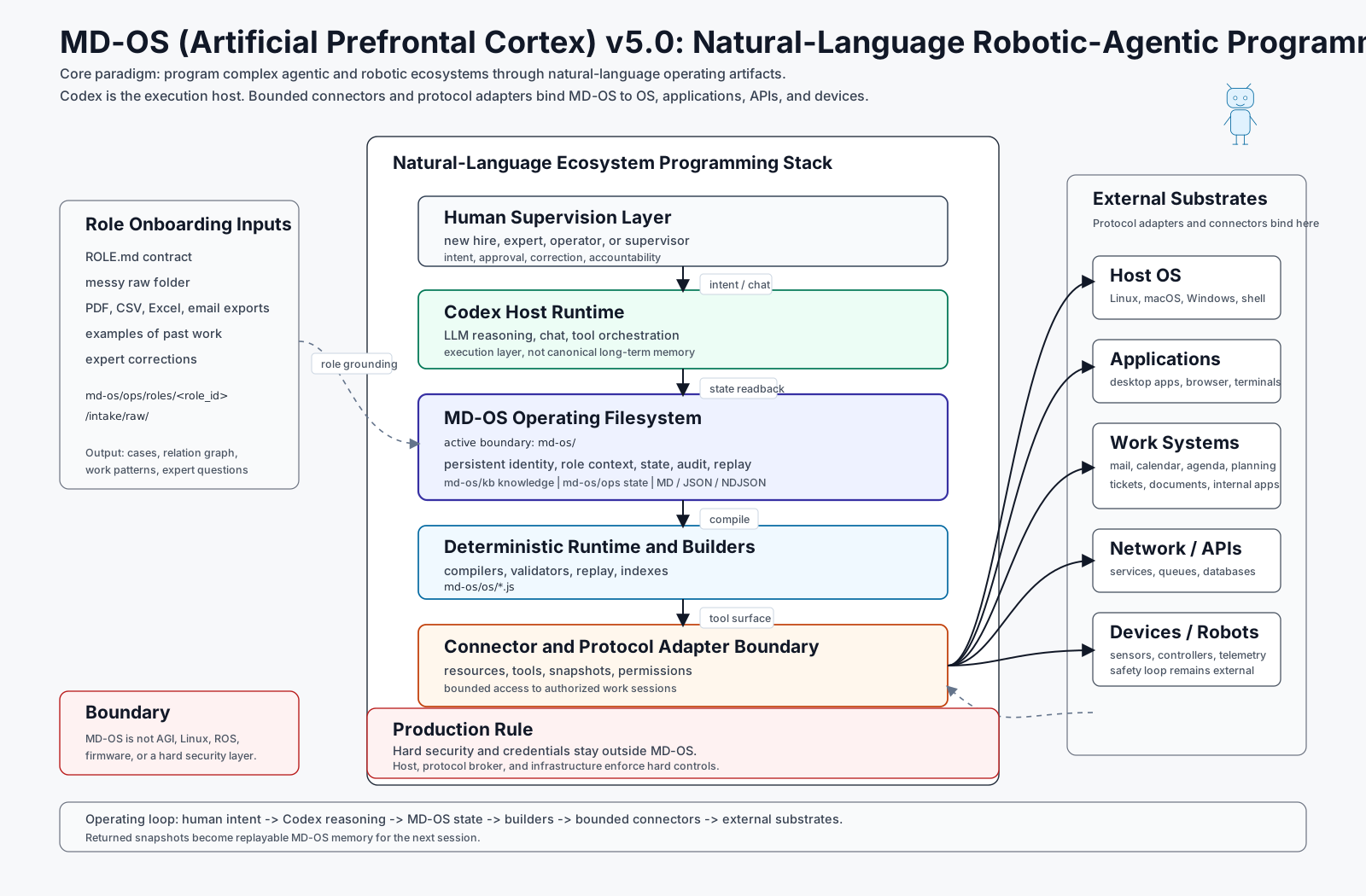
The diagram should be read from the center outward.
At the center is the static LLM. This is the base model: the part that understands language, reasons, explains, and helps decide what to do.
Around it is the MD-OS semantic runtime. This is the operating layer. It keeps track of memory, tasks, connectors, policies, snapshots, and semantic actions.
On the right are API, MCP, and connectivity. These are the channels through which the system can talk to external tools, files, services, devices, and host runtimes.
At the bottom is the result: a Dynamic Virtual LLM. This is not a second neural network trained inside the model. It is the behavior produced when a static LLM is surrounded by persistent operational context.
The easiest metaphor is:
The LLM is the reasoning core.
MD-OS is the external operating structure around it.
Or, more vividly:
MD-OS gives a static LLM an external semantic nervous system.
That nervous system is made of readable files, connector contracts, task state, policies, snapshots, audit trails, and deterministic rebuilds. Because those parts live in the filesystem, people can inspect them, correct them, rebuild them, and move them across sessions.
In more precise terms:
MD-OS virtualizes semantic-operational nodes on disk.
Those nodes are neural-like only by analogy. They are not biological neurons, model weights, hidden activations, or a second neural network. They are readable operating objects: notes, tasks, policies, connector profiles, state files, snapshots, artifacts, schedules, and rebuild outputs. The links between them create a filesystem-backed semantic neural overlay around the model.
A Short Public Explanation
MD-OS is a project that gives LLMs operational memory and a structure for action.
A normal LLM receives a question and produces an answer. MD-OS organizes tasks, tools, rules, and memory around the model, so a request can become a controlled action connected to the state of a project.
The main idea is simple: if LLMs complete sentences, MD-OS tries to complete tasks. It looks at what is missing in a process and prepares the next useful step.
A Very Short Version
MD-OS is like an operating layer for helping an AI work.
The AI understands language. MD-OS organizes the work.
Together, the model does not only answer. It can follow tasks, remember state, use bounded connectors, and propose the next step.
LinkedIn-Style Version
LLMs today complete text.
The question is: can they also complete tasks?
MD-OS starts from that idea. It builds an operating layer around a static LLM: memory, connectors, rules, snapshots, and semantic actions.
The model remains at the center, but it no longer works only inside a chat. It is connected to an operating space where each request can become a task, each task can produce state, and each state can suggest the next useful step.
In short:
from text completion
to task completion
How Hard Problems Are Examined
For a difficult question, MD-OS can use a bounded thought experiment to make the reasoning inspectable. It first states a principle and its assumptions, then changes one relevant condition and derives what would necessarily follow. Symmetry, limiting cases, or contradiction can reveal which assumption is doing the real work.
The result is not treated as proof. It must end by naming the observation, calculation, formal proof, or real experiment that could verify or falsify it. This Einstein-inspired method is used only when it helps distinguish competing paths; it is not a ceremony added to ordinary requests.
How To Say It Safely
Avoid opening with claims such as:
I created a new AI.
It can do everything.
It is fully autonomous.
It is a universal system.
Better:
MD-OS is a semantic operating layer for LLMs.
Also acceptable, when the boundary is stated clearly:
MD-OS is a semantic operating system for agents.
Here “operating system” does not mean a kernel, Linux replacement, robotics middleware, or autonomous intelligence. It means an Operating Filesystem: a readable control plane where semantic instructions, state, policies, connectors, artifacts, and rebuilds organize supervised work.
Or, more publicly:
MD-OS is a structure that helps an AI turn requests into organized,
supervised work.
From Batch Files to Markdown Files
In MD-OS, the operational file is no longer only a rigid batch of commands. It becomes a Markdown artifact:
# Procedure: urgent ticket triage

## Objective

Understand whether the ticket blocks production.

## Conditions

- if the customer is blocked
- if a critical code is missing
- if approval is required

## Actions

- classify the ticket
- search for similar cases
- propose the next step
- ask for confirmation if authorization is required
This Markdown is not a volatile prompt. It is a small natural-language
operating program: readable by a person, interpretable by Codex, and
materialized by deterministic builders under md-os/os/.
The difference from a classic batch file is that Markdown can carry meaning, context, rules, exceptions, links, and operating intent.
The Semantic Network
MD-OS Markdown files can link to each other:
- a procedure links to a policy;
- a policy links to a permission model;
- a role links to operational cases;
- a ticket links to a recurring cause;
- a connector links to the enterprise system it can read;
- an action links to its required approval.
This creates a logical, semantic, and operational network.
With Obsidian, one of the strongest visual surfaces for Markdown files, MD-OS can be read as a map of connected concepts. The system is not a closed box. It is a visible network of operational knowledge.
Operational Intelligence As A Semantic Space
MD-OS can also be understood as a semantic action field around a reasoning model.
A normal batch file lists deterministic commands in one direction. MD-OS keeps the readability of that idea, but adds semantic dimensions:
- intent
- memory
- project state
- active tasks
- permissions
- policies
- connector capabilities
- artifacts
- expected state transitions
- audit and replay
Each dimension narrows or opens the possible next actions. Together, they form an inspectable operating space. A request is not only answered; it is placed inside a field of possible supervised actions.
In compact form:
semantic dimensions + bounded procedures + persistent state
  -> semantic action field
  -> supervised task completion
This is where operational intelligence appears in MD-OS. It does not come from hidden autonomy or a magical new model. It comes from the coordination of many small readable semantic units: programs, work items, connector contracts, policies, snapshots, journals, builders, and artifacts.
The result is emergent in the practical sense: each unit can be simple, but the filesystem can combine them into a larger space of useful next actions. Because that space is written down, humans and agents can inspect it, correct it, and rebuild it.
This is the important difference from a hidden neural network. The semantic nodes live on disk as ordinary files. They can be opened, edited, linked, rebuilt, audited, and replayed.
From Clues To Claims
MD-OS is useful not only for tasks, but also for ideas.
In ordinary work, a theory, a diagnosis, or a project decision often starts as a clue: a note, a pattern, a weak signal, a partial calculation, or a recurring problem. The risk is that these pieces remain scattered, or that an early intuition is later presented as if it were already proven.
MD-OS gives this process a practical lifecycle:
clue or intuition
  -> note or intake material
  -> line of thought
  -> frozen principle
  -> derivation
  -> prediction or readback
  -> correction
  -> replay
In concrete filesystem terms:
- heuristic material becomes notes, journal entries, intake files, and raw analysis;
- a line of thought becomes linked notes, work items, natural-language programs, and dependency sketches;
- a frozen principle becomes source of truth, such as
md-os/kb/**,ME.md,AGENTS.md, or a canonical program; - a derivation becomes a deterministic script, a builder, or another reproducible transform;
- prediction or readback becomes a declared gate, connector snapshot, audit result, or comparison artifact;
- correction becomes a change proposal, source edit, rebuild, and replay.
The important guardrail is simple:
A result can be reproducible and still not be a prediction.
A strict prediction requires the target, time or version, input state, assumptions, and comparison method to be declared before readback. If the result is checked against data already known to the system, MD-OS should call it retrodiction. If it depends on unfinished assumptions, it should call it conditional. If it is only a useful direction, it should remain heuristic.
This is the practical meaning of saying that MD-OS can linearize thought in geometric-procedural form. Ideas become nodes. Dependencies become edges. Procedures become paths. Checks become gates. The filesystem does not make a theory true by storing it, but it preserves the chain well enough for humans and tools to inspect where a claim came from, what could falsify it, and what changed after correction.
Why MD-OS APFC
APFC means Artificial Prefrontal Cortex. It names the bounded executive control plane of MD-OS, not a biological claim. The metaphor is functional: it allocates attention and working context, schedules and interrupts work, gates permissions, coordinates input/output, and compares expected results with verified readback.
MD-OS APFC receives small semantic instructions, similar in spirit to UNIX processes and old batch files, but richer:
- objectives;
- roles;
- conditions;
- limits;
- exceptions;
- procedures;
- expert questions;
- allowed actions;
- actions that require approval.
Each file is a small operating unit. Alone, it does little. Inside an ordered
structure, with a host model as the execution layer and md-os/ as the
operational boundary, many small verified agentic processes become a system.
Codex Orchestration
Codex is not the persistent identity of the system. Codex is the host runtime: it reads files, reasons, converses, uses tools, and coordinates operations.
MD-OS is the persistent operating memory:
Codex = reasoning and orchestration runtime
MD-OS = persistent operating filesystem
MCP = tool and resource surface
md-os/os = deterministic builders
md-os/ops = runtime state
md-os/kb = stable knowledge
This separation matters. The agent does not live only in chat. It also lives in the files that declare what it knows, what it must do, what it cannot do, what it has done, and what it intends to do next.
The New-Hire Desk Problem
A concrete workplace example makes the purpose clearer.
In many companies, a new employee does not receive a clean operating manual. They receive a desk, an account, a few vague explanations, and then a truck of messy work backs up to the desk:
- old PDFs;
- spreadsheets;
- exported ticket lists;
- email threads;
- calendar obligations;
- half-written procedures;
- screenshots;
- internal notes;
- exceptions known only by senior people;
- repetitive tasks that nobody has properly formalized.
The new hire is expected to understand the role, connect the material, discover what matters, avoid internal mistakes, ask the right expert questions, and start producing useful work quickly.
MD-OS treats that pile as an operating input, not as a training inconvenience. The company can place the raw material for one role into:
md-os/ops/roles/<role_id>/intake/raw/
MD-OS APFC then helps turn the pile into an operating map:
raw files
  -> inventory
  -> entities
  -> cases
  -> recurring work patterns
  -> candidate operations
  -> expert questions
  -> role-bounded next actions
Through Codex chat, the employee can ask MD-OS APFC what to do, why it matters, what evidence supports the answer, what is missing, and which action is safe to take next.
Where MCP resources are available, MD-OS APFC can also work on the employee’s real surface: mail, calendar, agenda, planning systems, documents, tickets, internal applications, files, and dashboards. These are the tools already authenticated for the employee and supervised by the employee. MD-OS does not require a new custom API project before the role can become useful.
The practical target is not only learning. It is assisted execution.
MD-OS APFC can automatically structure the pile, prepare task lists, draft replies, classify tickets, correlate similar cases, propose next actions, update rebuildable state, and execute bounded connector actions when the action is explicit, authorized, and auditable. When the evidence is weak or the role boundary is unclear, MD-OS APFC stops and produces questions for a human expert instead of inventing policy.
This is the workplace value of MD-OS: reduce onboarding time, reduce repeated internal errors, preserve operational knowledge, and help a new employee move from chaotic material to supervised useful action.
Transparency Instead of a Black Box
A raw LLM is often a black box:
- its goals are not always explicit;
- its memory across sessions is uncertain;
- its operating rules may not be written anywhere inspectable;
- its intended next actions may be unclear;
- its memory is not naturally reviewable or correctable.
MD-OS changes the paradigm.
Goals, rules, limits, tasks, cases, connectors, questions, and operating intentions are placed in readable files. A person can open those files, correct them, discuss them, version them, rebuild them, and verify them.
This makes the operating process transparent:
what the agent knows -> knowledge files
what it must do -> agenda and work items
what it may do -> policy and connector registry
what it did -> journal and snapshots
what is unclear -> expert questions
what it wants to do next -> next steps and operating programs
The Biological Metaphor
MD-OS can also be understood through a biological metaphor.
A living organism does not work because one single cell does everything. It works because many small, specialized, coordinated units produce complex behavior.
In MD-OS:
- Markdown files are small operating cells;
- deterministic builders are metabolic processes;
- connectors are senses and limbs;
- the journal is historical memory;
- policies are the immune system;
- Codex is the momentary operating nervous system;
md-os/is the filesystem body that preserves everything.
The result does not come from one giant file. It comes from the orchestration of many small readable units.
This is the difference from simple prompting. The model is not asked to remember everything. Instead, an operating environment is built where many small semantic instructions can cooperate.
The Core Point
MD-OS is a semantic operating system for agents.
It is not a kernel. It is not Linux. It is not ROS. It is not AGI.
It is an Operating Filesystem: a way to program a complex agentic and robotic ecosystem in natural language while keeping everything readable, reconstructible, auditable, and correctable.
The short formula is:
MS-DOS batch file
  -> readable deterministic commands

MD-OS Markdown file
  -> readable semantic instructions
  -> linked into a logical network
  -> orchestrated by Codex
  -> materialized by deterministic builders
  -> exposed to real tools through MCP
  -> made transparent to humans
This is MD-OS (Artificial Prefrontal Cortex) v5.0: a shift from deterministic textual commands to semantic operating programs inside a filesystem designed for agents, robots, enterprise tools, and real continuity.